President John Dramani Mahama has outlined a series of interventions aimed at addressing the persistent glut of food crops, particularly maize and rice, to stabilise prices and protect farmers’ incomes.
Central to the plan is a GH¢200 million allocation to the National Buffer Stock Company to purchase excess produce from farmers. The commodities will be distributed to public institutions, including secondary schools, hospitals and prisons.
The President said the initiative was designed to absorb surplus produce from the market, reduce post-harvest losses and guarantee farmers ready buyers.
Beyond immediate market interventions, President Mahama said the government was investing in processing infrastructure to provide long-term solutions to recurring surpluses.
He announced that a new rice mill under construction along the Yendi Road in Tamale, together with a planned facility in the Fumbisi Valley, would process locally grown rice for supply to the buffer stock system and the School Feeding Programme.
In addition, five maize processing factories are expected to be established across the country to absorb excess maize for both domestic consumption and export.
President Mahama expressed confidence that the measures would reduce waste and create new economic opportunities within the agricultural value chain.
He noted that similar interventions were implemented last year, when GH¢100 million was released to support the purchase of excess maize, but storage facilities remained full as the country approached another planting season.
The President made the announcement during his two-day “Resetting Ghana” tour of the Northern Region, where he also launched and inspected several development projects.
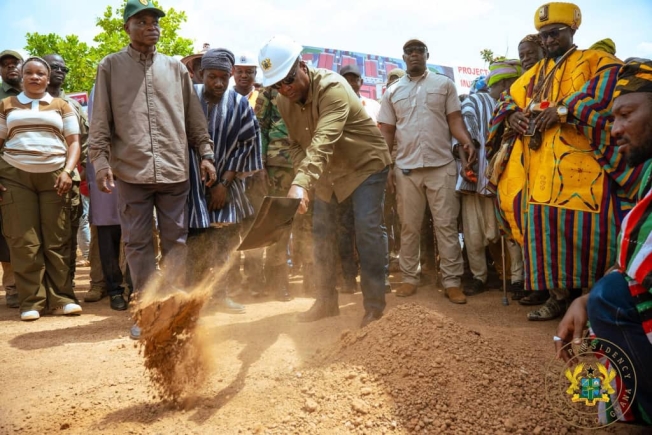
As part of the tour, he cut sod for the construction of 24-hour economy model markets at Bimbilla and Kukuo in the Tamale Metropolis. The facilities will include storage warehouses, security posts, healthcare services and food courts to support continuous trading.
“The plan is to establish similar markets in all the 261 districts across the country to promote continuous commercial activities,” he stated.
Addressing longstanding water challenges in Tamale, President Mahama said the government was mobilising local resources to revive a major water supply project after a €277 million external facility was withdrawn due to Ghana’s debt default.
He indicated that the new system would deliver an additional 30 million gallons of water daily, while faulty pumps at the Dalun Water Treatment Plant would be replaced. Plans are also underway to extend water supply from Yapei to parts of the metropolis.
On healthcare, the President announced the procurement of a new catheterisation laboratory for the Tamale Teaching Hospital to improve the diagnosis and treatment of heart conditions and reduce referrals to Accra and Kumasi.
He clarified that tricycles being distributed under the Free Primary Healthcare Programme were intended to support mobility for health workers in rural communities, not to function as ambulances.
Meanwhile, Ahmed Ibrahim, Minister for Local Government, Chieftaincy and Religious Affairs, warned contractors against delays and substandard work, cautioning that contracts would be revoked for non-performance.
The President, accompanied by Haruna Iddrisu, Minister for Education, also inspected progress on a 300-capacity hostel project at the Bimbilla EP College of Education.
President Mahama reiterated his administration’s commitment to fiscal discipline and economic stability, stressing that improving market access remained key to unlocking growth in Ghana’s agricultural sector.