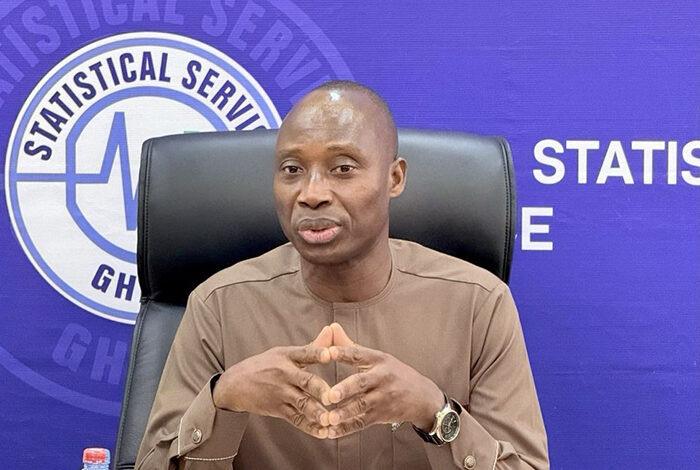
Ghana’s business sector has expanded significantly over the past decade, but employment creation has not kept pace, with only 7.7 per cent of businesses operating formally, Government Statistician Dr Alhassan Iddrisu has disclosed.
Speaking at the launch of the maiden edition of Ghana in Numbers 2025 in Accra, Dr Iddrisu said the findings highlighted persistent challenges in business formalisation and the sector’s capacity to generate jobs.
Data from the publication show that Ghana had 2.64 million businesses in 2024, with micro-enterprises accounting for nine out of every 10 establishments.
“Establishments nearly tripled between 2014 and 2024, while the people working in them doubled,” Dr Iddrisu said, noting that business growth had outpaced employment creation.
He said although Ghana’s unemployment rate declined from 14.6 per cent in 2023 to 12.8 per cent in 2025, more than 70 per cent of jobs remained informal.
The findings, he said, underscored the need for measures to promote business formalisation and improve the quality and sustainability of employment.
The report also highlighted the scale of informal cross-border trade, much of which has remained outside conventional trade statistics.
Dr Iddrisu said Ghana’s first survey of informal cross-border trade recorded GH¢38.4 billion worth of goods traded informally with Togo, Burkina Faso and Côte d’Ivoire.
He said the figure was equivalent to 1.4 times the previously recorded trade flows with the three neighbouring countries, indicating significant commercial activity that had not been adequately captured in official records.
Ghana also recorded a goods trade surplus of GH¢148.3 billion in 2025, with exports exceeding imports.
Beyond business and trade, Ghana in Numbers 2025 brings together statistics on population, social development, governance, the environment and the Sustainable Development Goals in a single publication.
Dr Iddrisu said the publication was intended to provide a common evidence base for policymakers, businesses and other stakeholders to guide decision-making.
“When we have our cabinets, parliaments, boardrooms, and newsrooms working from the same figures, the debate moves from whose figures are right to what do we do about them,” he said.
The publication is supported by a web portal offering district-level data, interactive maps and downloadable statistics.
Dr Iddrisu said the ultimate objective was to ensure that statistics informed decisions and delivered measurable development outcomes.
“A statistic changes nothing until someone acts on it,” he said.